Sunday, 22 March 2015

Final Days in Florida

6th March – Palm Bay

A chance conversation with a fellow camper last night led to us accepting an offer for our inflatable kayak.  So after we ‘did the deal’ we set off from Fiesta Key driving the 280 miles up to Palm Bay – mostly along I-95 and passing Miami and Fort Lauderdale.


7th – 11th Mar – Long Point City Park

 Using this campground as our base we visited our friends, Maggie and Grant.  We had stayed with them back in the beginning of December.  Paul spent some time fishing from both the campground on the Indian River and also from nearby Sebastian Inlet state park where Alison had a long walk along the seashore. It was sunny and the beach was almost empty with a few surfers having fun in the waves.

Our campsite was on an Island but there was also another smaller island accessed via a bridge.  Walking around one day we came across a tortoise.

One day we had some excitement when a Racoon was spotted wandering around under RVs; very unusual to see one like this in daylight so near people.  Close up it looked very skinny, possibly   So the Ranger was alerted, caught it, and put into a cage – it was not normal behaviour for a Racoon not to put up a fight.  
old or ill?

12th Mar – McLarty Treasure Museum

We visited the McLarty Treasure Museum which had an excellent video explaining all about the 1715 Spanish Plate Fleet and the quantity of Treasure subsequently found. 

Prior to 1715 gold and silver mined in the New World was being accumulated by Spain because it was unsafe for ships to sail across the Atlantic due to the seven year war. At the end of July 1715 11 ships laden with all the treasure set sail heading for Spain. A hurricane decimated the fleet just off-shore and, although 1000 people survived, many were drowned and only one ship ran aground.  The beach in August was a harsh refuge; fresh water, food and shade were sparse.  People would bury themselves in the sand at night to avoid the biting insects.  Eventually help came from St Augustine further north.

However, only some of the Treasure was recovered during the 18th century, leaving a lot still beneath the waves.  In the 1950s Kip Wagner discovered where the survivor/salvager encampment had been – his dog found a make-shift fresh water well.  During the 1960s Treasure worth millions has been brought up from this region of the coast; silver pieces of eight, gold doubloons, gold bars, pearls, jewellery etc.  Every year something is discovered from the beach – it made us want to get a metal detector and start beach combing ……

Barrier Island Sanctuary

We then visited the Barrier Island Sanctuary which highlighted the importance of the area as a nesting site for Sea Turtles.  Three species nest here each year; Green, Logger Head and Leatherbacks. 

Whilst hiking the nature trail we surprised a family of Racoons.  The mother and one youngster fled but the other youngster climbed up a tree.  It then realised that was a mistake as we were stood almost eye to eye.  We watched as it turned round on the tree and jumped back down on the ground before  
running off in the opposite direction of its mother.

One of the weirdest trees we have come across is the “Strangler Fig”. It starts life similar to Mistletoe. As it grows on the host tree it throws down roots
circling the tree and eventually rooting itself. Apparently it does not harm the host tree.

Just as we were leaving the camp site Paul spotted this Woodpecker making its nest in the side of the rangers hut, the sound must have been deafening inside.


13th Mar – Travel to St Augustine

We travelled further up the I-95 to St Augustine where we were hoping to meet up with friends, Sue and Ian, whom we visited in February.  However due to illness they weren’t able to make it.  After setting up came we popped into the city for a visit in the late afternoon and were delighted to find such a quaint historical town with lots going on.  The Spanish and British influence over the years was evident.

14th Mar – St Patrick’s Day Parade

The streets were lined for the annual St Augustine’s St Patrick’s Day parade which started at 10am.  The whole weekend was designated as a Celtic Festival covering all things Irish and Scottish; including Star War Storm Troopers in Kilts ………

 
After the parade we toured the fort; the Castillo de San Marcos.  Built at the end of the 17th Century this fort was for many years the northernmost outpost of Spain’s New World Empire.  The fort’s use, over the centuries, reflected the history of Florida as the state was passed from Spain to Britain to Spain and then the USA.

After lunch in the Prince of Wales pub (including sticky toffee pudding and custard) we spent some time at the Celtic Festival grounds watching some Irish dancing and tossing the Caber.


Thursday, 5 March 2015

The Keys

26th Feb – Travel to Key Largo

We headed further south through Florida City and onto the Florida Keys.  Key Largo is one of the first Keys just 50 miles from Miami and our campsite is at MM 101.5.  Everything along the road – Route 1 – is measured in miles from Key West.

27th Feb – Flamingo – Everglades

Flamingo is a section of the Everglades that was closer to our campsite in Key Largo so we drove down to the Bay and then worked our way back.  At the Visitor Centre there was an Osprey in his nest by the dock, just feet away from humans.  We saw another Osprey nest and also a Roseate Spoonbill getting his lunch at Eco Pond. Spoonbills are not rare but are very shy birds, so to be able to photograph one this close was a rare treat.


At one of the Overlooks we stopped at a lady volunteer who pointed to a Barred Owl resting on some nearby branches.  We watched talking to the Ranger in low tones whilst Paul took some photos.  We were astounded when another visitor came along and started shaking the branch so that the owl flew off!
You might forgive a child/youngster but this was a man of our generation. The Ranger spoke to him but Paul would have used different words!


28th Feb – John Pennekamp Coral Reef SP

Just a mile up the road was John Pennekamp State Park.  Looking at a map of this coastline there is a continuous zone, between here and Miami, of parks and sanctuaries which protect the USA’s only living coral reef.

We took a glass-bottomed boat tour out to one of the coral reefs.  On the journey out there was a sucker fish hanging onto the glass; but he came off once we picked up speed.  We saw a lot of coral; mostly Fan, Feather and Stag coral and also Sponges in the shape of vases. There were many different types of fish; also a shark, some sea turtles and 2 different types of stingray.  It was a most delightful and informative trip.


1st Mar – Travel to Fiesta Key

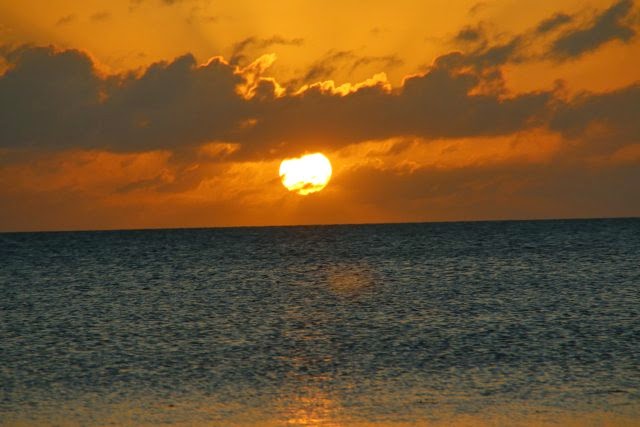
The 30 miles to this campsite took nearly an hour due to the weight of traffic on the road but was easy to find as there is nothing else on the Key.  After an hour by the pool we gathered with other campers to watch the sunset over the Bay – a ritual we did every evening whilst here.

2nd Mar – Dolphin Research Centre

With 27 dolphins in various pools at the DRC you got a feeling of being surrounded by dolphin.  Two of the dolphins had given birth just a week ago.  They used artificial insemination to keep the gene pool mixed.  Some of the dolphins were 4th generation from the start of the film Flipper.  They also   had 4 sea lions and some iguana which are free to roam. Iguanas are not native to Florida but the Centre catches them, and neuters them before releasing.

There was a lot going on with many people taking part in the various ‘packages’ offered by the Centre to get close to a dolphin.  At all the presentations the dolphins were encouraged to ‘play’. 

 However we left feeling that there seemed as much emphasis on entertainment as education.  Dolphins were still doing the usual tricks seen in shows including getting one to paint on a T-shirt with a brush in its mouth.

The most interesting presentation was about manatee rescues that they do.  We saw little evidence of research on Dolphins.

3rd Mar – Turtle Hospital

Driving further west we came across the Turtle Hospital and joined a 90 minute talk and tour of the facilities.  The hospital currently has 47 turtles, of which 13 are permanent, and there are 4 out of the 7 different Sea Turtle species.  We learnt about the issues and hazards sea turtles encounter; one of which is “Bubble Butt”.  This is when a turtle has endured damage to its shell which affects its  
buoyancy and is treated by adding weights to the shell.

The tour took around the tanks where we fed the turtles and you could see the beautiful colours of their shells.  The guide told us the story of each turtle.  One turtle had many health issues when rescued which left it so weak they could not put it in water for nearly 2 months. 
This in turn led to the equivalent of bed sores which then required treatment.  It also had lockjaw and had several weeks of therapy opening and shutting its mouth until it could eat on its own accord.

The hospital originally began as a motel with a swimming pool full of fish.  Back when Teenage Ninja Turtles was popular a child asked why there were no turtles which gave the owner the idea to find out more and before long became a place for rescued turtles to recuperate.  It now has the support from local vets.


4th Mar – Key Deer and Offshore Fishing


Up early to get Paul down to the marina at sunrise, and onto the Blue Haven boat, to go Offshore Fishing for the day with 3 other fishermen and a crew of 2.


Alison drove over 7-mile Bridge to Big Pine Key in search of the Key Deer Wildlife Refuge.  The Keys have their breed of miniature deer.  With only 600 left they have been cross-bred with white-tailed deer in order to increase the gene-pool.  The deer wander unrestricted around the Key and were spotted at the side of the road and in people’s gardens. 


By the bridge to No-Name Key Alison paid a quick visit to see the inside of the No Name pub which is literally dripping with $1 notes.  In this out-of-the-way pub it has become tradition for dollar notes to be stuck onto ceilings, walls, pillars and the bar.  Some estimates say as much as $60,000.  Every year as much as $8000 is donated to charities.

Paul arrived back at the marina at 3pm.  The ‘catch’ – of over 50 Yellowtail, some Mahi-mahi, and other miscellaneous fish – all were duly filleted by the crew and shared out among the 4 fishermen.  The pelicans provided entertainment fighting over the left-overs. 

The freezer was now full.  Guess what we will be eating for the rest of the month?

5th Mar – Fiesta Key

This is the furthest south we will be on this trip.  With less than 2 months left in USA we start heading north tomorrow.


The Everglades

18th Feb – Travel to Chokoloskee Island

An 80 mile drive took us further south, through Everglades City and across a causeway to Chokoloskee Island which is part of the Ten Thousand Islands Wildlife Refuge and within Everglades NP boundaries. From our campsite on the waterfront we could see the edge of Big Cypress National Preserve just across the bay.

19th Feb – Chokoloskee and Everglades

As the Island is about one square miles it didn’t take too long to explore.  There was an interesting original building that used to be the “local store” which was set up as a local museum and where a local writer signed one of his books that Alison bought.

We also paid a visit to the Everglades Gulf Coast Visitor Centre and Paul did some fishing.

20th Feb – Eastern River

The big freeze in the northern states tried to catch up with us.  Last night it was barely above freezing.  So we waited until it had warmed up in the afternoon before taking the kayak out to paddle the Eastern River trail in Fakahatchee Strand Preserve State Park. 

This whole area is protected with a series of different Reserves, Preserves, and Parks.


The river took us through mangrove tunnels to little lakes and then more mangrove tunnels.  It was quiet an exploration never knowing what we might come across.  We saw one alligator and many wading birds.  The trail goes all the way down to the Bay (up to 6 hrs paddle).


21st Feb – Boat Trip
 
It was too windy to attempt taking the kayak across the bay to the canoe trails in the Preserve. However, one of our neighbours, Scott, invited us to join him fishing on his boat. 


The Bay is one absolute maze of mangrove islands and inlets and we were glad Scott had GPS as we had no idea where we were.  Paul had some luck fishing – some Ladyfish which went back as not good eating, a flounder that also went back and a nice big Sea Trout which didn’t go back in.  Alison bird watched.  There were so many Osprey around – at least a dozen – as well as Heron and Egret.

22nd Feb – Travel to Midway Campground


My, how the weather had warmed up in 48 hours!  Our next campsite was only 30 miles away and was right in the middle of the Big Cypress Preserve, and only 15 miles from the Everglades NP border.  It had a large pond where Paul had a go at fishing, without any luck. 
The view of the lake in the morning mist was stunning.

We spent the afternoon at the Oasis Visitor Centre where we got our first real encounter with large Alligators which were sunning themselves in the water canal just below the boardwalk.  There were also Gar fish, turtles and more wading birds. 
 

23rd Feb – Loop Road

We drove the 26 mile scenic Loop Road stopping at regular intervals to watch the wildlife which was plentiful.  We hiked some of the Gator Hook Strand trail and encountered some beautiful clusters of dwarf cypress trees with air plants (mostly bromeliads) growing on them. 

Big Cypress is about one third cypress trees, most of which are the dwarf pond variety.  Most of the large Bald Cypress were logged in the first half of the 20th century as the wood was not prone to rotting.  Completion of the Tamiami Trail (road between Tampa and Miami, hence the name) in 1928 meant access for logging companies and oil exploration in the region.
 

As the Loop road finished near the edge of the Everglades we drove down for a quick visit to Shark Valley.  We walked along the small canal and saw so many alligators and birds.  In order to build roads above the water level, trenches were dug resulting in parallel canals.  The winter is the dry season here and so wildlife was congregating near this water.  The opportunity for visitors and alligators to get so close to each other was surprising but I guess for the alligators living here it is like growing up next to a highway – you get used to continuous traffic and learn that if one veers off towards you, then you get out of the way fast.  So although the ‘gators look asleep as soon as a tourist gets too close they move – very quickly.  We were surprised at how close some people would get for a ‘photo opportunity’.

24th Feb – Shark Valley – Everglades NP

At Shark Valley we listened to a Ranger talk and took the Tram ride on a 15 mile loop to an observation tower.  We saw some alligators and many birds.  Armed with a bird book we can identify nearly 20 different birds and tell the difference between a Great Egret, a Snowy Egret and a Great White Heron and a Little Blue Heron (which is white before it goes blue!).  The central region of   With up to 60 inches of rain in a 7 month period the banks of Lake Okeechobee, to the north, flood and the water begins its slow journey south through the Everglades and out to the Gulf of Mexico. Water management systems and water quality from outside the parks are of serious concern.  Water from Big Cypress also feeds into this area. 
southern Florida is a valley with the West coast at an elevation of around 18ft and the East coast around 26 ft above sea level.

25th Feb – Turner River Scenic Drive

The Turner River Drive did not take long.  At our lunch break at the Visitor Centre we saw Manatee in the river which was at least 8 miles from the Bay.  We continue along the Tamiami Trail visiting the various points of interest.  One was a boardwalk through a grove of Old Cypress Trees that survived the loggers.

Tomorrow we would leave the Everglades and head for the Keys.